New Metric in YouTube Analytics

YouTube just introduced “Unique Reach” in YouTube Analytics, and it’s worth knowing about.
If one person watches your video 3 times, that’s still 3 “views” and 1 “unique viewer.” Nothing new there.
However, if one person watches your video on a TV with 2 friends, YouTube may now count that as 3 people uniquely reached.
Clearly, YouTube wants to speak the language of TV, where advertisers care about how many humans are actually in the room.
Now, the catch…
It’s an estimate.
YouTube can’t actually see you and your family lying on the couch in your pajamas.
Rather, the metric is modeled using viewing patterns, demographics, device type, even time of day… and then validated against third-party data from companies like Nielsen.
In other words, YouTube is making a pretty sophisticated guess about how many people were actually watching your video… and then calling it a metric.
One annoying limitation: currently, you can’t sort this by long-form videos only. It combines long-form + Shorts together. I asked YouTube’s analytics team why, and they basically replied, “Good point. We’ll look into that.”
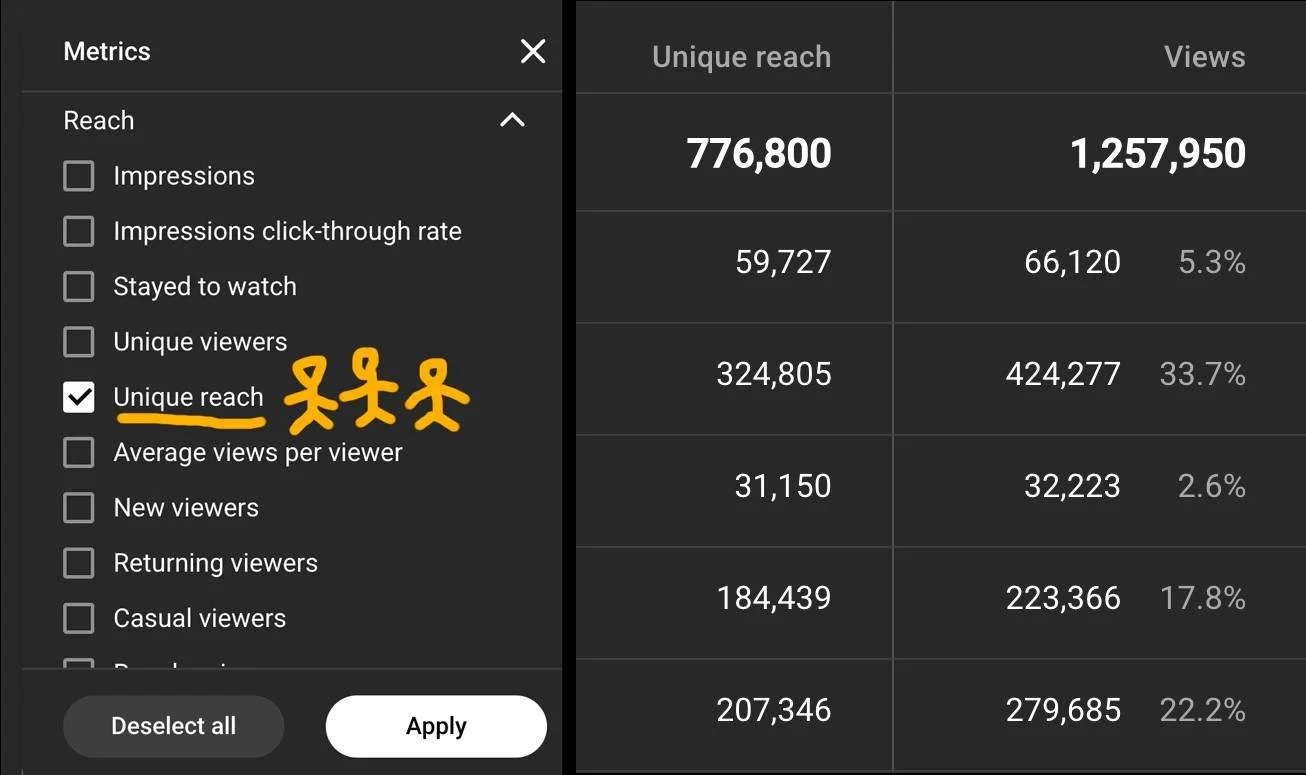
Also, you may notice that the “Unique Reach” of a video can actually be lower than the total views, which sounds counterintuitive until you remember this is largely measuring co-viewing on TVs, not mobile devices. (They figure there's probably not 3 people huddled around your iPhone watching your latest upload.)
Overall though, I think this is a pretty useful metric for framing total audience impact.
Plus, when you think about it, multiple people watching your video together in a living room is pretty cool: You're basically now a producer for television.
Need help understanding your channel’s analytics? Schedule here and our team would be happy to take a look.